Salar La Isla: Science for a Future With Sustainable Lithium
A team of researchers from the Faculty of Biological Sciences and the Millenium Institute Center for Genome Regulation (CGR, as per its acronym in Spanish) seeks to characterize the biodiversity at the plant and microbial level of this salt flat located in the Atacama region, in addition to deciphering its historical changes. The objective: to provide the scientific evidence necessary for Chile to make informed decisions about lithium extraction.
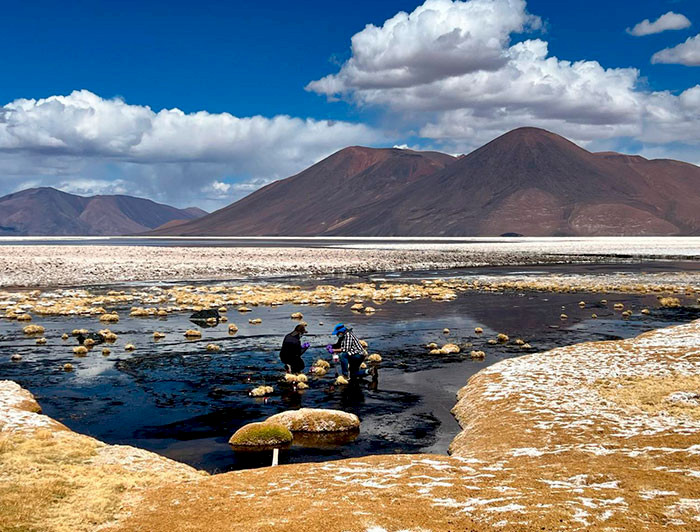
photo_camera As stated by Rodrigo Gutiérrez, member of the Faculty of Biological Sciences and principal researcher from the Millenium Institute CGR, “science is the tool that will allow us to balance development and conservation, guaranteeing a responsible future for the next generations.”
Amidst the global boom in lithium mining, Chile has developed a National Strategy that seeks to reconcile economic development with the protection of biodiversity and unique ecosystems. In this context, the National Agency of Development and Research (ANID, as per its acronym in Spanish) launched a call to study three salt flats in the north of Chile: Aguilar, Grande, and La Isla. The main objective is to document the existing biodiversity through scientific evidence, before making decisions based on the extraction of mineral resources.
One of the main focuses is on the Salar La Isla, located in the Atacama Region, an arid and inhospitable ecosystem where researchers from the Millenium Institute Center for Genome Regulation (CGR), linked to UC Chile, are working to characterize its biodiversity at a plant and microbial level, as well as decipher its historical changes.
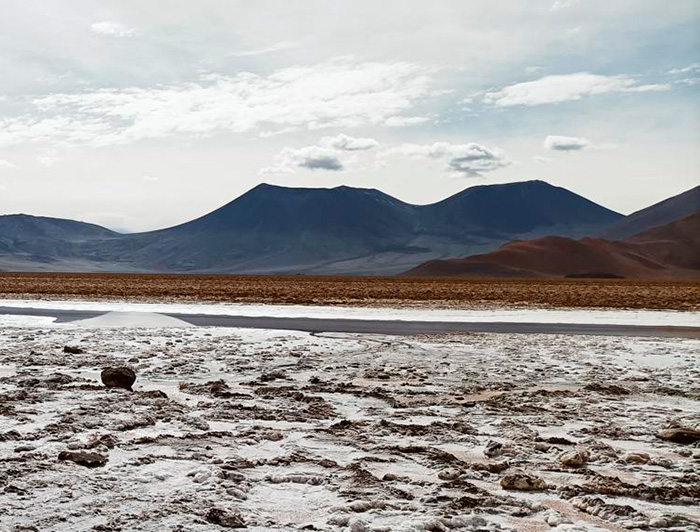
The initiative will run for 12 months and brings together an interdisciplinary team led by academic Rodrigo Gutiérrez and PhD Catalina Ibarra, members of the Faculty of Biological Sciences and researchers at CGR, with the participation of Claudio Latorre, professor from the same faculty, and Mauricio González, professor of the Institute of Nutrition and Food Technology (INTA, as per its acronym in Spanish), Universidad de Chile.
The project will follow three main lines of research. The first one is coordinated by Rodrigo Gutiérrez and Catalina Ibarra, who study the current vegetation and its dynamics with the salt flat ecosystem. In the second, Mauricio González focuses on determining the microbial composition and diversity of the ground and sediments associated with the vegetation. Finally, Rodrigo Gutiérrez and Claudio Latorre lead a paleo-genomic exploration (the study of the DNA of extinct species) from ancient sediments to reconstruct the evolutionary history of the salt flat.
“In Salar La Isla we face a unique, fragile ecosystem, full of evolutionary history. With the support of ANID, our multidisciplinary team is characterizing its biodiversity, from its vegetation and microorganisms to the genomic traces that reveal its past,” explains Rodrigo Gutiérrez, one of the leaders of the team.
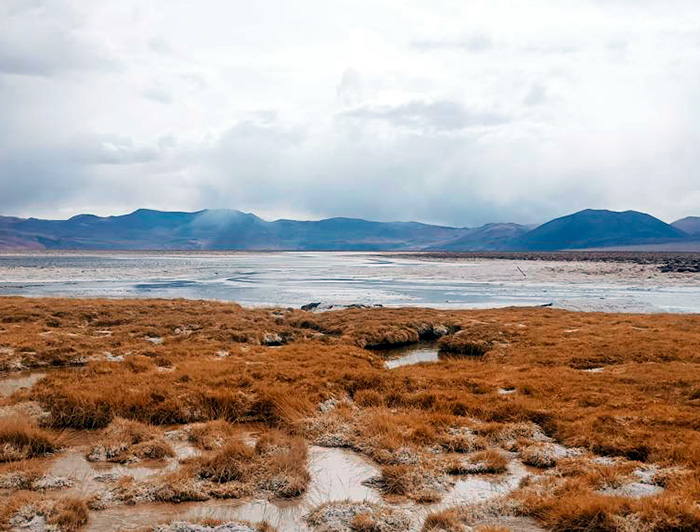
Research on the past and present of the salt flat
The comparison between the past and present records will allow us to understand the changes that have taken place over time to the composition of the salt flat in its current state.
As expressed by academic Rodrigo Gutiérrez, “this knowledge is key: it will allow us to understand how the salt flat was formed throughout time, and what the role is of each species in the balance of the ecosystem.”
Unlike other salt flats with active bodies of water, the three salt flats selected for this study (including Salar La Isla) present extremely arid conditions. However, they remain valuable reserves of biological and geological information.
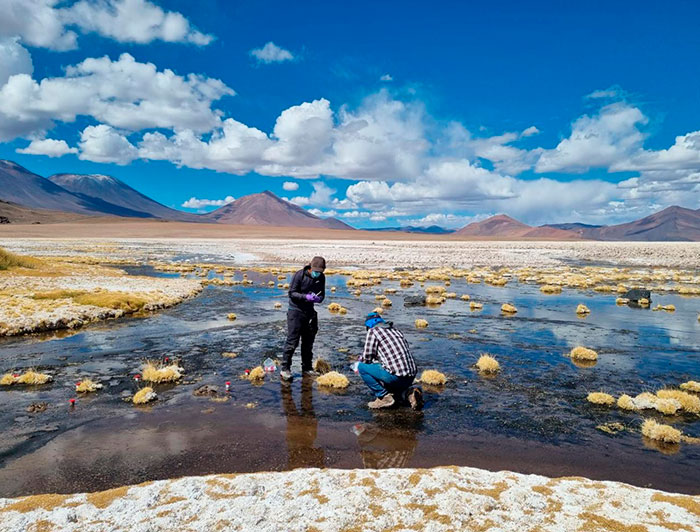
“The key is in identifying the historical traces at Salar La Isla and determining the biodiversity and composition of its species and their roles in the ecosystem,” explains Alexis Gaete, CGR affiliated researcher. “What we look for is to reconstruct the ecological history of the salt flat and to report on which species coexist in this environment, and with this, future decision may be made regarding its possible exploitation.”
The results of this investigation will be delivered to ANID and will use scientific evidence to guide public policies related to the extraction of lithium and other minerals.
As stated by Professor Gutiérrez, “with this data, we seek to provide the scientific evidence necessary for Chile to make informed decisions about lithium extraction, moving towards truly sustainable mining that does not jeopardize the biological richness of our territories.” He adds, “science is the tool that will allow us to balance development and conservation, guaranteeing a responsible future for the next generations.”
This work provides previously unknown data on extreme biodiversity and raises a critical question for Chile: how can we move toward sustainable mining without compromising our understanding of biological systems that are unique on the planet, and the ecological balance of its territories?


